Digital Marketing Career Guide: Skills, Salary and Job Roles in India
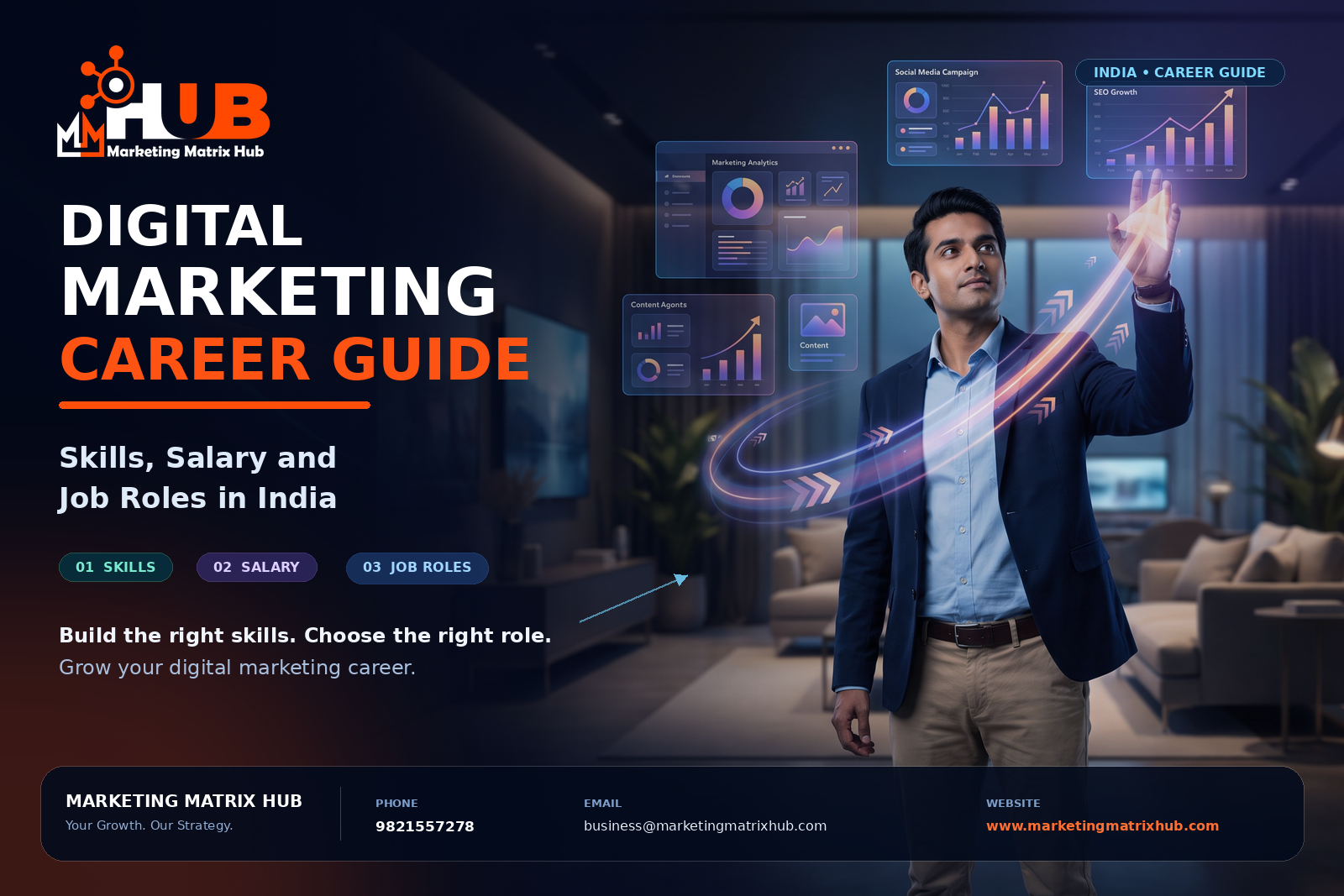
Digital Marketing Career Guide 2026: Skills, Salary, Job Roles and Career Opportunities in India
Want to build a career where creativity, technology, data and business growth come together?
Digital marketing has become a broad career field with opportunities in SEO, Google Ads, social media, content marketing, performance marketing, analytics, email marketing, AEO, GEO and AI-powered search.
If you are a student, fresher, graduate, working professional or someone planning a career switch, you may have questions like:
Is digital marketing a good career in India? Which digital marketing skills should I learn? What jobs are available? How much can a digital marketer earn? Do I need a degree or technical background? How can I get my first digital marketing job?
This guide covers all of these questions in a practical way.
Is Digital Marketing a Good Career in India?
Digital marketing offers multiple career paths in India, from entry-level executive positions to specialist, managerial and strategic roles.
Unlike some traditional career paths, digital marketing allows you to specialise in a particular area based on your interests and strengths.
You could build a career in:
Search Engine Optimization Google Ads Meta Ads Performance Marketing Social Media Marketing Content Marketing Email Marketing Marketing Analytics Conversion Rate Optimization Influencer Marketing AEO GEO AI Marketing Digital Strategy
Your earning potential and career growth can depend on several factors, including your experience, specialisation, location, company, industry, communication skills, portfolio and ability to produce measurable results.
For example, someone who knows how to publish social media posts and someone who can plan campaigns, manage advertising budgets, analyse conversions and generate qualified leads are performing very different levels of work.
That is why your long-term goal should not simply be to learn digital marketing.
Your goal should be to become good at solving marketing problems using digital channels.
What Is Digital Marketing?
Digital marketing is the promotion of a business, product, service or brand through digital channels.
These channels can include:
Search engines Websites Social media Google Ads Meta Ads Email Video Mobile applications Content platforms Online communities AI-powered search platforms
A digital marketer can be responsible for increasing website traffic, generating leads, improving brand visibility, increasing sales, building customer relationships or supporting customer retention.
For example, imagine a software company wants to generate more qualified leads.
A digital marketing team could use:
SEO → Content → Google Ads → Landing Pages → LinkedIn → Email → Analytics → Conversion Optimization
The job is not simply to generate traffic.
The real objective is to understand whether that traffic is contributing to the business.
Why Are There So Many Digital Marketing Jobs?
Digital marketing is not one single profession.
It is an ecosystem of different specialisations.
A company may have separate professionals responsible for SEO, paid advertising, social media, content, analytics and performance marketing.
This creates different career opportunities for people with different interests.
If you enjoy writing, content marketing could be suitable.
If you enjoy numbers and campaign optimisation, performance marketing or analytics could be interesting.
If you enjoy search engines and websites, SEO could be the right direction.
If you enjoy creativity and communication, social media and content could be a natural fit.
The important thing is to identify an area where you can build real expertise.
Digital Marketing Job Roles in India 1. Digital Marketing Executive
Digital Marketing Executive is one of the common entry-level positions for freshers.
In this role, you may get exposure to multiple areas instead of working on only one specialisation.
Your responsibilities may include:
Social media management Basic SEO Keyword research Content publishing Website updates Email marketing Competitor research Basic paid advertising Lead-generation activities Marketing reports
This can be a useful starting point because you can understand how different marketing channels work together.
However, don't remain at a basic execution level forever.
Use your early experience to identify the area where you want to specialise.
If you enjoy Google search, websites, content and understanding why some pages perform better than others, SEO can be a strong career path.
An SEO specialist may work on:
Keyword research Search intent On-page SEO Technical SEO Content optimisation Internal linking Competitor research Backlink analysis Search Console Website audits Organic traffic analysis Conversion-focused SEO Beginner SEO skills
Start by learning:
Keywords Search intent Title tags Meta descriptions Headings URLs Internal links Content optimisation Intermediate SEO skills
Then move into:
Technical SEO Schema markup Content clusters Backlink analysis Search Console Google Analytics Website audits Advanced SEO skills
Experienced SEO professionals can move into:
Enterprise SEO International SEO Programmatic SEO Technical SEO strategy SEO forecasting Entity optimisation Knowledge graph concepts AI search visibility AEO GEO
SEO is no longer simply about inserting keywords into an article.
Modern SEO requires an understanding of search intent, useful content, technical website health, entities, user behaviour and business objectives.
Do you enjoy numbers, testing and measurable results?
Paid advertising could be a suitable career path.
A PPC specialist manages paid advertising campaigns designed to reach specific audiences and generate actions such as clicks, leads, registrations or sales.
Typical responsibilities include:
Keyword research Campaign creation Ad copywriting Audience targeting Budget management Bid optimisation Conversion tracking Landing-page optimisation A/B testing Performance reporting
Important metrics include:
CTR: Click-through rate
CPC: Cost per click
CPA: Cost per acquisition
CPM: Cost per thousand impressions
ROAS: Return on advertising spend
Conversion Rate: Percentage of users who complete the desired action
A strong PPC specialist does not simply spend money on advertisements.
They continuously ask:
Which audience is converting?
Which keyword is producing results?
Which advertisement is performing better?
Where are users dropping off?
How can the campaign generate better business results?
4. Social Media Manager
Social media marketing is much more than posting pictures every day.
A professional social media manager may be responsible for:
Content strategy Instagram marketing Facebook marketing LinkedIn marketing YouTube X Community management Reels Short-form video Influencer collaborations Social campaigns Engagement Performance reporting
A social media professional needs a combination of:
Creativity + Communication + Platform Knowledge + Analytics
You need to understand what type of content a particular audience actually wants.
You also need to understand that a large number of followers does not automatically mean successful marketing.
The real objective could be:
Brand awareness Website traffic Leads Sales Community growth Customer engagement 5. Content Marketing Specialist
Content marketing is another major digital marketing career path.
Content professionals can work on:
Blog articles Website pages Landing pages Case studies LinkedIn content Newsletters Video scripts E-books Social media content Lead magnets
Modern content marketing is not simply about writing long articles.
A good content marketer needs to understand:
Who is searching?
What are they trying to find?
What problem are they trying to solve?
What information do they need?
What should they do after consuming the content?
This is where content starts contributing to the overall marketing funnel.
6. Performance Marketing Specialist
Performance marketing focuses heavily on measurable outcomes.
Depending on the business, the objective could be:
Leads Sales App installations Purchases Registrations Revenue Customer acquisition
A performance marketer may work across:
Google Ads + Meta Ads + Analytics + Landing Pages + CRO + Remarketing
Performance marketing requires strong analytical thinking.
You should understand metrics such as:
CTR CPC CPM CPA Conversion Rate ROAS CAC Revenue Lead quality
One of the biggest differences between basic digital marketing and performance marketing is the focus on measurable business outcomes.
7. Email Marketing Specialist
Email marketing remains an important part of customer communication and retention.
An email marketing professional may work on:
Newsletters Promotional campaigns Lead nurturing Customer segmentation Email automation Drip campaigns Customer retention A/B testing Campaign reporting
Strong email marketing requires more than sending emails.
You need to understand:
Who should receive the email?
What should the subject line say?
What problem does the message solve?
What action should the reader take?
What happens after the click?
8. Marketing Analytics Specialist
If you enjoy numbers, reporting and finding patterns in data, marketing analytics could be a strong career direction.
Marketing analysts can study:
Website traffic Lead generation Conversion rates Campaign performance Customer acquisition User behaviour Marketing ROI Channel performance
You should become comfortable with:
Google Analytics Google Search Console Excel Google Sheets Looker Studio Marketing dashboards
As you gain experience, you can move into more advanced areas such as attribution, forecasting, experimentation and customer analytics.
9. AEO and GEO Specialist
Search behaviour is changing.
People are increasingly asking questions directly to AI-powered systems and answer engines.
This has created growing interest in:
AEO, or Answer Engine Optimization
and
GEO, or Generative Engine Optimization
These areas overlap with traditional SEO but focus more on how information is structured, understood and surfaced in answer-oriented and generative search experiences.
A marketer working in this area may need to understand:
Search intent Question-based content Structured content Entity optimisation Knowledge graphs Brand mentions Schema markup First-party expertise AI search visibility Content authority
For SEO professionals, learning about AEO and GEO can add another skill layer to their existing search expertise.
10. Digital Marketing Manager
With experience, a digital marketer can move into management.
A Digital Marketing Manager may be responsible for:
Digital strategy Campaign planning Budget allocation Team management Agency coordination Lead generation Brand growth Marketing KPIs Performance reporting Marketing technology
At this stage, your role changes.
You are no longer only asking:
“How do I execute this campaign?”
You are also asking:
“Which marketing activities should the company invest in, and why?”
This requires a broader understanding of customers, competition, budgets, business objectives and revenue.
Digital Marketing Salary in India
One of the most searched questions among students and professionals is:
“How much does a digital marketer earn in India?”
There is no single salary for digital marketing.
Compensation can vary significantly based on:
Job role Experience Location Industry Company Specialisation Portfolio Technical skills Communication Performance Leadership responsibilities
Entry-level digital marketing positions may commonly fall around the ₹2 lakh to ₹5 lakh per year range according to published career and salary guides, although actual offers can be lower or higher depending on the employer and candidate.
As professionals gain specialised experience, salaries can move into higher ranges.
Experienced specialists, managers and senior marketing professionals can earn substantially more, particularly when they handle large budgets, teams, enterprise accounts or revenue-focused campaigns.
For example, a professional who can manage a significant advertising budget while maintaining strong acquisition economics may have a different compensation profile from someone performing basic campaign execution.
A simple career progression
Fresher
Digital Marketing Intern Digital Marketing Executive SEO Executive Social Media Executive
↓
Early Career
SEO Specialist PPC Specialist Content Specialist Social Media Manager Performance Marketing Specialist
↓
Mid-Level
Senior SEO Specialist Senior Performance Marketer Marketing Analyst Digital Marketing Manager
↓
Senior Level
Digital Marketing Head Marketing Director Growth Lead Digital Strategy Lead Consultant
These are career paths, not guaranteed promotions. Your progression depends on your skills, results, opportunities and chosen specialisation.
What Skills Do You Need for a Digital Marketing Career?
One common mistake beginners make is trying to learn every marketing tool at once.
You don't need to become an expert in everything.
Start with the fundamentals.
Learn:
Keyword research Search intent On-page SEO Technical SEO Content optimisation Internal linking Link building Search Console Analytics SEO reporting 2. Paid Advertising Skills
Learn:
Google Ads Meta Ads Campaign structures Audience targeting Conversion tracking Budget management Ad copy Landing pages Remarketing Performance analysis 3. Content Skills
Learn:
Copywriting Blog writing Website content Landing-page copy Social media content Video scripts Content strategy Research
Good content should not simply contain keywords.
It should answer the user's question and move them toward a useful next step.
4. Analytics Skills
A marketer should know how to interpret data.
Start with:
Traffic CTR CPC Conversion rate CPA ROAS Leads Revenue Engagement Customer acquisition cost
Don't just report numbers.
Learn how to explain:
What happened?
Why did it happen?
What should we change?
What should we test next?
Technical Skills vs Soft Skills
Digital marketing requires both technical and soft skills.
Technical skills
You can develop skills in:
SEO PPC Analytics CRM Email marketing Content management Conversion optimisation Marketing automation Reporting AI marketing tools Soft skills
You should also develop:
Communication Creativity Research Problem-solving Time management Presentation Critical thinking Adaptability Teamwork
As you move toward senior positions, soft skills become increasingly important because you will have to communicate with clients, management, designers, developers, sales teams and other marketers.
Do You Need a Degree for Digital Marketing?
A specific digital marketing degree is not always required.
People enter digital marketing from many educational backgrounds, including:
Marketing Business Commerce Management Mass communication Economics Communications Computer-related backgrounds
A degree can be useful, but practical knowledge and experience also matter.
Suppose two candidates apply for an SEO position.
Candidate A says:
“I completed a digital marketing course.”
Candidate B says:
“I conducted keyword research, built a content strategy, optimised pages and tracked organic performance through Search Console.”
Candidate B has something practical to discuss.
This is why building projects is so important.
Are Digital Marketing Certifications Worth It?
Certifications can help you learn structured concepts and demonstrate knowledge.
You can explore certifications in:
Google Ads Google Analytics SEO Meta advertising HubSpot Email marketing Content marketing
But don't make the mistake of collecting dozens of certificates without practical experience.
A certificate can show:
“I studied this.”
A portfolio can show:
“I can actually do this.”
Ideally, build both.
How to Build a Digital Marketing Portfolio Without a Job
This is one of the biggest problems faced by beginners.
You need experience to get a job.
But how do you get experience without a job?
Build your own projects.
Project 1: Create a Website
Create a simple website around a topic you understand.
Work on:
Keyword research Website structure SEO Content Internal linking Analytics
Document your work.
Project 2: Create a Google Ads Campaign
You can create a hypothetical campaign for a business.
Prepare:
Campaign structure Keywords Ad copy Target audience Landing page Conversion strategy
You can clearly mention that it is a practice project.
Project 3: Build a Social Media Strategy
Choose a fictional or small business.
Create a 30-day strategy containing:
Content ideas Post formats Reels ideas Captions Content calendar Engagement strategy Measurement plan Project 4: Create an SEO Audit
Choose a public website and analyse:
Technical SEO Metadata Content Internal linking Website structure Search intent Page performance Content opportunities
Turn your findings into a professional PDF or presentation.
Now you have something to show during an interview.
What Digital Marketing Tools Should Beginners Learn?
You don't need to master every tool available.
Start with a practical set.
SEO Tools
Learn tools and platforms related to:
Google Search Console Google Analytics Keyword research SEO auditing Website crawling Competitor analysis Advertising Platforms
Understand:
Google Ads Meta Ads Manager LinkedIn Campaign Manager Content Tools
Learn:
WordPress or another CMS Canva Basic image editing Basic video editing Analytics
Learn:
Google Analytics Looker Studio Excel Google Sheets Productivity
You can also learn:
Google Workspace Notion Project management platforms AI productivity tools
Once you choose a specialisation, expand your toolkit according to the work you actually do.
Digital Marketing Career Roadmap for Beginners Step 1: Learn the Fundamentals
Start with:
SEO + Content + Social Media + PPC + Analytics
You don't need advanced knowledge at this stage.
Your goal is to understand how digital marketing channels work together.
Step 2: Choose a Specialisation
After understanding the basics, select one primary area.
You could choose:
SEO
PPC
Performance Marketing
Social Media
Content Marketing
Analytics
Don't worry if you change your specialisation later.
Your first choice does not have to define your entire career.
Step 3: Build Practical Projects
Create two to four projects.
Track what you did.
Save screenshots.
Record your results.
Document what you learned.
Step 4: Build Your Portfolio
Your portfolio can include:
About Me
Skills
Projects
Case Studies
Certifications
Results
Contact Information
Keep it simple and professional.
Step 5: Apply for Internships and Jobs
Look for roles such as:
Digital Marketing Intern Digital Marketing Executive SEO Executive SEO Specialist PPC Executive Performance Marketing Executive Social Media Executive Content Marketing Executive
Don't wait until you know everything.
Marketing is a practical profession, and you will continue learning after getting your first role.
Step 6: Develop a Specialisation
Once you have practical exposure, go deeper.
For example, an SEO professional can move into:
SEO Executive → SEO Specialist → Senior SEO Specialist → SEO Manager
A performance marketer could move through:
Performance Marketing Executive → Performance Marketer → Senior Performance Marketer → Performance Marketing Manager
The exact path differs between companies.
Step 7: Learn Strategy and Business
As you become more experienced, learn:
Marketing funnels Customer acquisition Conversion optimisation Budget planning Attribution Customer lifetime value Revenue metrics Team management Business strategy
This helps you move from an execution-focused role toward strategic marketing responsibilities.
Digital Marketing vs Traditional Marketing
Digital marketing provides access to a wide range of measurable data.
For example, instead of simply asking:
“Did people see our advertisement?”
Digital marketing can help answer questions such as:
How many people saw it?
How many clicked?
How many visited the website?
How many submitted a form?
How many eventually purchased?
Attribution is not always perfect because customers can interact with multiple channels before making a decision.
However, digital platforms provide marketers with a significant amount of data that can be used for optimisation.
That is why analytics has become such an important digital marketing skill.
Is Digital Marketing Suitable for Freshers?
Yes.
But you should have realistic expectations.
You don't need to know everything before applying for your first job.
However, you should be able to demonstrate that you understand:
Marketing fundamentals + one practical specialisation + basic analytics.
For example, someone applying for an SEO role should understand:
Search intent Keyword research On-page SEO Technical SEO Internal linking Content optimisation Search Console Basic analytics
Someone applying for a PPC role should understand:
CTR CPC Conversion tracking Campaign structure Audience targeting Budget management Landing pages Performance analysis
Your ability to explain these concepts clearly can make a significant difference during an interview.
Freelancing vs Full-Time Digital Marketing Jobs
Both career paths have different advantages and responsibilities.
Full-Time Digital Marketing Job
A full-time role can provide:
Structured learning Team experience Regular income Client exposure Mentorship Experience with larger campaigns Internal training
This can be useful for beginners who want to understand how professional marketing teams operate.
Freelancing
Freelancing can provide:
Flexible working Multiple clients Direct client communication Greater control over projects Opportunity to build a personal brand Potential to build an independent business
However, freelancing also requires you to handle:
Client acquisition Pricing Contracts Communication Project management Payments Reporting
For many beginners, gaining practical experience first can make freelancing easier later.
What Do Employers Look for in a Digital Marketer?
A strong candidate is not necessarily someone who lists the largest number of tools on their CV.
Employers want people who can understand a problem and work toward a solution.
Instead of saying:
“I know SEO.”
You can explain:
“I conducted keyword research, created a content cluster, optimised website pages and monitored organic performance.”
Instead of:
“I know Google Ads.”
Explain:
“I understand campaign structure, keyword targeting, conversion tracking, budget optimisation and performance analysis.”
There is a major difference between knowing the name of a tool and knowing how to use that tool to solve a marketing problem.
Common Digital Marketing Mistakes Beginners Make 1. Trying to Learn Everything
SEO, PPC, social media, email, design, video, analytics, automation and coding can quickly become overwhelming.
Start broad.
Then specialise.
Certificates can help, but they should support practical experience.
Build projects alongside your learning.
Followers are only one metric.
A business may care more about:
Leads Sales Revenue Customer acquisition Retention
Understand the difference between vanity metrics and business metrics.
4. Ignoring Analytics
Marketing without measurement becomes difficult to improve.
Learn how to read data and turn it into decisions.
5. Copying Competitors
Competitor research is useful.
Copying everything they do is not a strategy.
Understand your audience and develop a marketing approach around your own objectives.
6. Ignoring AI
AI is becoming part of research, content creation, analysis, automation and search.
You don't need to let AI replace your thinking.
Instead, learn how to use AI to:
Research faster Generate ideas Analyse information Automate repetitive work Improve workflows Explore customer questions
Always review and verify important information before publishing or using it.
The Future of Digital Marketing Careers in India
Digital marketing continues to evolve as technology and consumer behaviour change.
Several areas deserve attention.
AI-Assisted Marketing
AI tools can support:
Research Content ideation Data analysis Automation Personalisation Customer communication
The marketer still needs to provide strategy, context, judgement and quality control.
AI Search and GEO
People are increasingly using AI-powered systems to find information.
This has created interest in Generative Engine Optimization, or GEO.
Brands are exploring how their information can become more visible and accurately represented across AI-driven search experiences.
This makes knowledge of:
Brand entities Structured content Authoritative sources Search intent Schema Digital PR Content quality Brand mentions
increasingly relevant to modern search strategies.
First-Party Data
Businesses are paying increasing attention to the data they collect directly from customers and website visitors.
Marketers who understand customer data, privacy, segmentation and personalisation can bring additional value to marketing teams.
Conversion Optimization
Generating traffic is only one part of marketing.
The next question is:
What happens after the visitor arrives?
Conversion Rate Optimization focuses on improving the percentage of users who take a desired action.
This could be:
Submitting a form Making a purchase Booking a consultation Signing up Downloading a resource Starting a trial Marketing Automation
Automation can help businesses manage repetitive processes such as:
Lead nurturing Email sequences Customer segmentation Follow-ups Reporting Workflow management
Learning automation can help marketers work more efficiently.
How to Increase Your Digital Marketing Salary
If your goal is career growth, don't focus only on asking for a higher salary.
Focus on becoming more valuable.
Build expertise in an area where businesses can measure results.
For example:
SEO + Analytics
Google Ads + CRO
Performance Marketing + Data
Content + SEO
AEO + GEO + SEO
Marketing Analytics + Automation
Paid Ads + Landing Page Optimisation
A specialised professional who understands both marketing and business outcomes can bring more value than someone who only performs basic tasks.
Also develop:
Communication Presentation Client management Reporting Strategy Leadership
These skills become increasingly important as you move into senior positions.
A Practical 6-Month Digital Marketing Learning Plan Month 1: Marketing Fundamentals
Learn:
Digital marketing basics Customer journey Marketing funnel Target audience Competitor research Basic analytics Month 2: SEO and Content
Learn:
Keyword research Search intent On-page SEO Content optimisation Internal linking Technical SEO basics
Build your first SEO project.
Month 3: Paid Advertising
Learn:
Google Ads basics Meta Ads basics Campaign structure Audience targeting Ad copy Conversion tracking
Create a practice campaign.
Month 4: Analytics
Learn:
Google Analytics Search Console Excel Google Sheets Looker Studio Marketing KPIs
Create a basic marketing dashboard.
Month 5: Specialisation
Choose one area and go deeper.
For example:
SEO
or
Performance Marketing
or
Social Media
or
Content Marketing
or
Analytics
Build another project focused specifically on your chosen area.
Month 6: Portfolio and Job Search
Create:
LinkedIn profile Resume Portfolio Case studies Project documentation
Then start applying for internships and entry-level positions.
At this point, you should be able to talk about what you actually did rather than only explaining what you studied.
The Most Important Advice for Beginners
Don't wait until you feel completely ready.
Digital marketing changes constantly.
There will always be another:
Algorithm update Advertising feature AI tool Marketing platform Analytics system Search trend Content format
Your career advantage comes from developing the ability to learn continuously and apply what you learn.
Instead of asking:
“Which course will guarantee me a job?”
Ask:
“Which skills can I demonstrate to an employer?”
Instead of asking:
“How many certificates should I get?”
Ask:
“What projects can I show?”
Instead of asking:
“Which tool should I learn next?”
Ask:
“Which business problem can this tool help me solve?”
That mindset can make your learning much more practical.
Final Takeaway
A career in digital marketing does not have one fixed path.
You can begin as a:
Digital Marketing Executive
and specialise in:
SEO, PPC, Performance Marketing, Social Media, Content, Analytics, AEO or GEO.
With experience, you can progress toward:
Senior Specialist → Manager → Head of Marketing → Marketing Director → Consultant or Entrepreneur
Your long-term career growth will depend on much more than knowing marketing terminology.
Focus on three areas:
Understand customers, positioning, funnels, search behaviour and business objectives.
Develop practical skills in SEO, advertising, analytics, content, automation and relevant marketing technologies.
Understand how your work contributes to leads, customers, revenue and growth.
The tools will continue changing.
The platforms will continue changing.
AI will continue changing the way people search, discover and consume information.
But the fundamentals remain important:
Understand the audience. Solve a real problem. Create something useful. Measure the result. Learn from the data. Improve continuously.
That is the foundation of a long-term digital marketing career.
Build Your Digital Growth Strategy With Marketing Matrix Hub
Marketing Matrix Hub helps businesses build and improve their digital presence through modern marketing strategies focused on visibility, audience acquisition, lead generation and business growth.
Our areas of digital marketing include:
SEO AEO GEO Performance Marketing Google Ads Social Media Marketing Content Marketing Brand Building Lead Generation Digital Strategy AI-focused Marketing
Whether you are launching a new business, trying to generate more qualified leads, improving your search visibility or exploring AI-powered search opportunities, your marketing strategy should be connected to your actual business objectives.
Ready to discuss your digital marketing goals?
Marketing Matrix Hub
Website: https://marketingmatrixhub.com
Phone: +91-9821557278
Email: business@marketingmatrixhub.com
Start with the right strategy. Build the right skills. Measure what matters.